
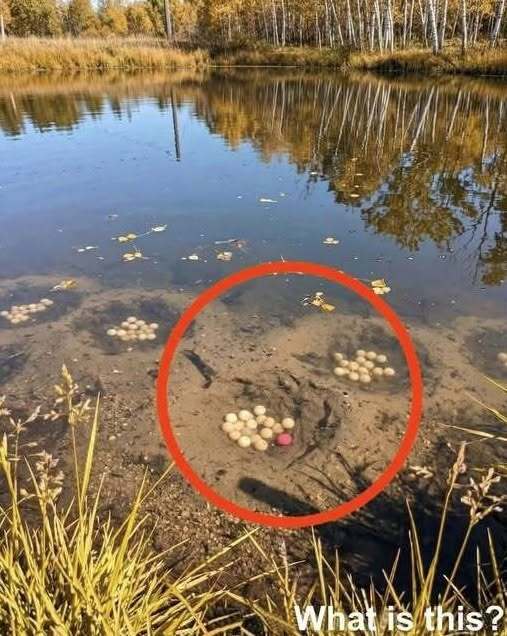

At first glance, the clusters in the shallow water really do look like eggs, especially because they’re sitting together in little depressions in the muddy bottom. But looking closely at the photo, these appear much more likely to be golf balls than eggs from a fish, amphibian, or other animal. They’re unusually uniform in size, perfectly round, and several have the off-white or yellowed appearance you often see when golf balls have been sitting underwater for a long time. One of them even appears pink, which is another strong clue that these are manufactured objects rather than eggs.
Golf balls can end up in lakes and ponds for several reasons. The most obvious is a nearby golf course, driving range, or someone simply practicing shots toward the water. Once they sink, currents, waves, and movement along the bottom can gradually collect them in the same low spots. Mud can settle around them, making the balls look like they were deliberately placed inside nests or holes. Over time, dirt and algae can also remove their bright white appearance, making them look surprisingly organic from a distance.
Real aquatic eggs generally don’t look like this. Frog and salamander eggs are usually surrounded by jelly, while many fish eggs are much smaller and often stick to vegetation, rocks, or gravel. Large, loose, perfectly round objects sitting uncovered on the lakebed would be unusual for most species. The consistent size and shape shown here point much more strongly toward golf balls.
So the mysterious “egg-filled holes” probably aren’t nests at all. They’re most likely collections of old submerged golf balls that have gathered in depressions along the lake bottom. Strange-looking, yes—but probably far less mysterious than they first appear.